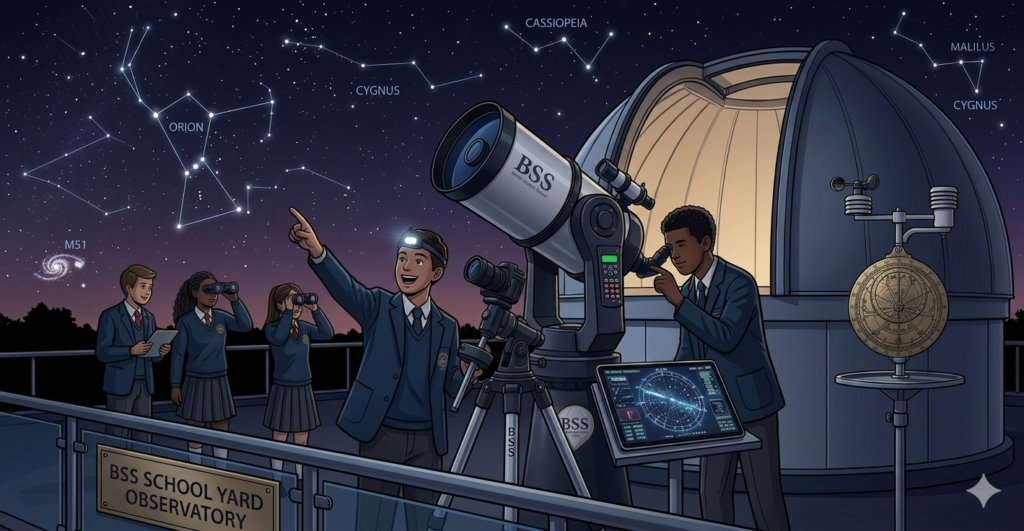
Stargazing and Cosmos: Mapping the Constellations from the School Yard Stargazing and Cosmos inspired students this week during our exciting school astronomy event, “Cosmos Night.” Students gathered after sunset to explore the mysteries of space using computerized telescopes, star-mapping apps, and traditional astronomy tools.
Exploring the Night Sky Equipped with modern telescopes and digital star maps, students observed the lunar surface, distant planets, and bright constellations in the clear night sky. The astronomy club carefully studied famous constellations such as Orion and Ursa Major while learning how ancient civilizations used the stars for navigation and storytelling.
Students were amazed by the detailed views of Saturn’s rings and Jupiter’s colorful gas bands. In addition, they practiced identifying stars and tracking planetary movement across the sky.
Learning Through Astronomy The activity encouraged curiosity, teamwork, and scientific thinking while helping students better understand astronomy and space science. Students also learned how astronomers use telescopes and technology to study distant galaxies and explore the universe.
Furthermore, students used traditional astrolabes to understand how people mapped the night sky before modern technology existed. This hands-on learning experience helped connect science, history, and exploration in a creative way.
To learn more about astronomy and space exploration, students explored educational resources from NASA: https://www.nasa.gov/
Inspiring Future Space Explorers At British Scientific School, we believe that STEM activities encourage students to ask questions and explore the world beyond the classroom. Stargazing and Cosmos helped students discover the beauty, mystery, and endless possibilities of our universe.
Students can also explore more science activities and school projects through our Student Blog: https://britishscientificschool.com/student-blog/ This unforgettable astronomy night reminded students that science is not only about facts and formulas, but also about curiosity, imagination, and discovery.